Saturday, 23 October, 2010

Some of the Somali regions that share a border with Ethiopia have been in a state of turmoil over the past few days. In the shifting patterns of this prolonged war in Somalia, the escalation of violence in the regions of Galguduud, Hiiran, Gedo and Bakool has illuminated some of the underlying geo-political dynamics that are at play in the volatile region of the Horn of Africa.
More than 400 Transitional Federal Government (TFG) soldiers, accompanied by up to 300 Ethiopian forces, raided the town of Baladweyn, Hiiran, in order to bring an end to the Islamists’ rule in the region; in Galguduud, hundreds of Ahlu Sunna Wal Jama (ASWJ) rebels attacked Cadaado, the region’s business hub which is governed by a tribal administration, with military equipment and reinforcements readily supplied by the Ethiopian government; in the border towns of Yeed and Ceel Berde, Bakool region, the Islamists are fending off the Ethiopian troops’ aggressive incursions; in the South-Western region of Gedo, TFG troops buttressed by the Ethiopian might and men wrestled the region’s capital, Beledxaawo, from the iron grip of the Islamists.
But while the Transitional Federal Government has its own reasons for driving out the Islamists from the region, what are the motives that underpin the Ethiopian involvement?
The News:
http://somalilandpre … stop-islamists-18783
Monday, 18 October, 2010

Central African countries plagued by the brutal rebellion of the Lord’s Resistance Army are working to reclassify the group as terrorists, the African Union said on Saturday.
At a meeting this week in the Central African Republic aimed at promoting a joint approach to the LRA, participants agreed to take steps to have the LRA classified as terrorists, rather than rebels, by the AU.
This would give affected countries greater access to international funds and require increased levels of judicial cooperation.
The group has killed about 2,000 people in the last two years, and displaced more than 400,000, according to the UN.
Representatives from Uganda, the Democratic Republic of Congo and Sudan met in Bangui on Wednesday and Thursday, along with Kenya, where they also agreed to step up joint military action.
The News:
http://www.reliefweb … Document&rc=1&cc=uga

Somali government troops and allied forces retook the southeastern town of Bulo Hawo near the Kenyan border Sunday after defeating al-Qaeda-inspired al-Shabaab Islamists, officials and witnesses said.
“We took control of the city after defeating the enemy,” Mohamed Abdi Kalil, the government’s governor for the province, said by telephone.
“Residents were applauding with happiness after they saw the national army back in town after living under the tough regime of the al-Shabaab,” he added.
Kalil said many al-Shabaab fighters had been killed in the fighting, while one government soldier was killed and two injured.
The News:
http://somalilandpre … lamist-militia-18742
Saturday, 16 October, 2010

The Sudanese army reacted angrily to the announcement by the United Nations peacekeeping chief Alain Le Roy yesterday in which he said that the world body intends to redeploy peacekeepers in the south to Abyei and other hotspots along the north-south border ahead of the referendum to create limited buffer zones.
On Friday an unnamed UN official told Reuters that as of yesterday, the United Nations Mission in Sudan (UNMIS) “significantly increased its troop presence in the Abyei area”.
The South Sudan referendum is required by a 2005 Comprehensive Peace Agreement (CPA) that ended the 21-year civil war between Sudan’s predominantly Arab and Muslim north and rebels in the largely Christian-animist south.
Preparations for the January 9 vote have proceeded haltingly amid political and logistical obstacles, and the southerners have accused the northerners of stalling, warning of violence if the referendum is delayed.
La Notizia:
http://www.sudantrib … pip.php?article36614

Heavy fighting between the transitional government soldiers and al-Shabaab has started at the out in parts around Beledweyn town of Hiran region in central Somali on Saturday morning, witnesses told Shabelle radio.
The fighting had reportedly started as many of al-Shabaab fighters attacked at El-gal village in out of Beledwyn town where there had been military base for the Somali government troops.
The real casualties of the fighting are unclear so far, but residents in the areas said that the sound of heavy weapon could be heard all directions in the areas.
The people of Beleweyn town have great fears over the fighting between the two sides as and reports from the town indicate that there was no businesses and public traffic movements there on Saturday morning.
The News:
http://www.shabelle. … n-in-central-somalia
Wednesday, 13 October, 2010

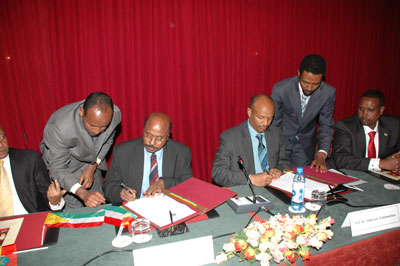
Ethiopia signed a peace deal on Tuesday to end 20 years of war with a rebel faction that has comprised the main threat to foreign oil and gas firms in the disputed Ogaden region, both sides said.
Abay Tsehaye, national security adviser to Prime Minister Meles Zenawi, welcomed the signing of the deal as something that would strengthen unity in the Horn of Africa country.
But the spokesman for a rival wing in the fractious Ogaden National Liberation Front (ONLF) run by former Somali navy chief Admiral Mohamed Omar Osman called the deal “irrelevant”, raising questions about its breadth and staying power.
The News:
http://www.biyokulul … t.php?articleid=3047
Tuesday, 12 October, 2010
Somali militants accused the nation’s transitional government of “baseless propaganda” after officials said the rebel group is on the verge of splitting up.
Government forces have seized more areas in the capital of Mogadishu with the help of African Union troops, officials said in a statement.
“These gains come amidst reports that the al-Shabaab’s second in command has withdrawn his forces from the city as rifts within the extremist group deepen in the wake of the failed Ramadan offensive,” a government statement said this week.
The transitional government has expanded the areas it controls in Mogadishu to seven districts that are home to 90 percent of the city’s population, according to the government.
The News:
http://edition.cnn.c … ants.feud/index.html
